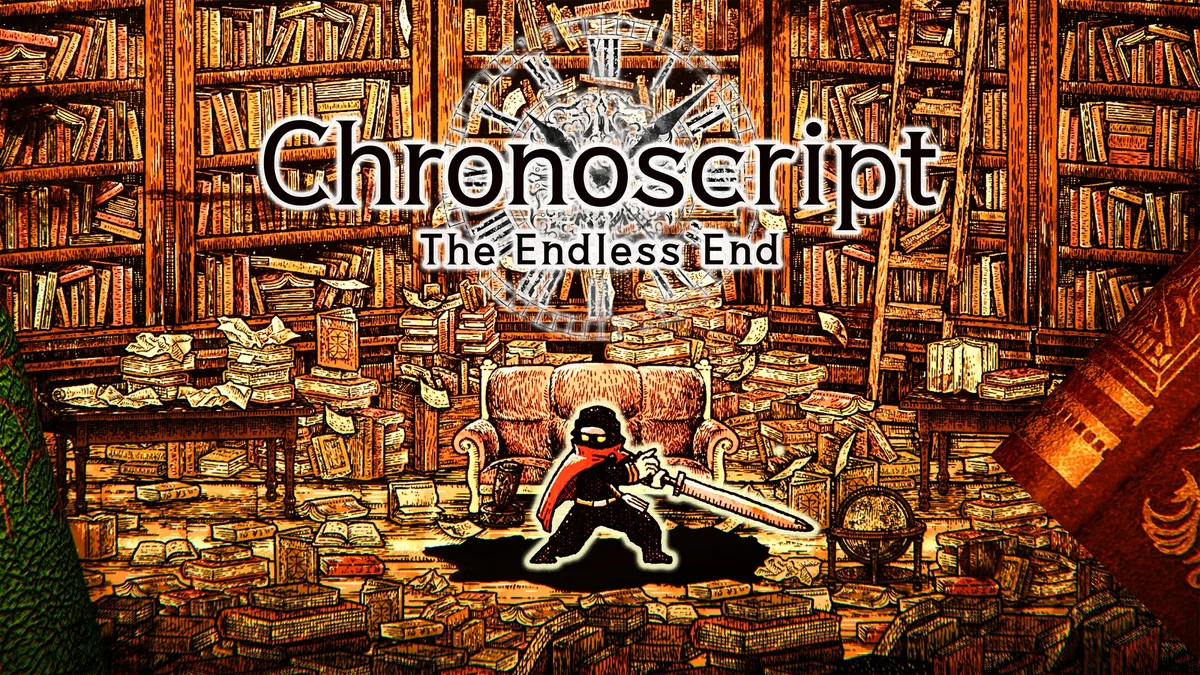
Chronoscript sends an editor between illustrated manuscript pages and a three-dimensional manor, turning a thousand-year story into a place to explore.
An unfinished story becomes a playable place
Chronoscript: The Endless End begins with an unusual job description. You are an editor trapped inside a manuscript, trying to bring a thousand-year story to its end. Shueisha Games describes the action-adventure as a journey across two connected worlds: the illustrated two-dimensional pages of the manuscript and the three-dimensional rooms of a manor. That is more than an art-style switch. It makes the act of reading, revising and exploring part of the game's premise.
The October ID@Xbox showcase brought the project back into view with a new trailer and an Xbox announcement. Shueisha's current game page lists an early summer 2027 release window for PS5, Xbox Series X|S, Xbox on PC and Steam. This matters because older coverage may still show a 2026 window. Use the publisher's current page for the latest schedule, and treat the window as a plan rather than a guaranteed day.
A feature on this game has to separate what is confirmed from what the concept invites us to imagine. The developer confirms exploration and action across the two spaces. It does not yet explain every puzzle or the full relationship between a page and its room in the manor. The appeal is precisely that unanswered question: how can a place you read alter the place you stand?
- 2D manuscript and 3D manor
- Single-player exploration action-adventure
- Current publisher window: early summer 2027
The page is a world, not a menu
Shueisha Games says the manuscript pages contain their own two-dimensional world. The editor does not simply click through text between fights; they move inside the illustrated story. That premise creates a different relationship with a book. A margin, an image and the arrangement of pages could all feel like geography. The publisher has not confirmed that every such detail is interactive, so it is better to view them as design possibilities rather than announced mechanics.
The official material emphasizes a pen-and-ink look. Drawn spaces can carry a sense of being authored, but they also need to work as readable game levels. A player should be able to tell where they can move, what is foreground and which shape is a threat. Good art direction can satisfy both needs. A striking frame brings someone to the trailer; clear visual rules help them play the level when the camera is no longer edited for a reveal.
The manuscript setting also gives enemies and discoveries narrative weight. The Xbox showcase describes facing twisted remnants of people who lost their lives in the waking world. That detail suggests the page is not a safe fantasy escape. The game's mystery may depend on understanding why those figures remain. We should not invent their backstories before release, but the official description already gives the action a more personal tone than a generic monster gallery.
A three-dimensional manor changes the question
The other half of the game takes place in a 3D manor. Moving from a drawn page into a spatial room should change how a player searches. In 2D, an obstacle might be visible as part of a composed illustration. In 3D, a hallway can hide another path behind a door or a turn. The publisher's two-world description creates an expectation that perspective itself will matter, though it does not publish a complete interaction rulebook.
The manor can also provide context for the manuscript. A book found in one room might suggest where to look next; a room might make a detail inside the story newly meaningful. Those are reasonable inferences from the premise, not confirmed puzzle solutions. Keeping that distinction matters because a preview should help readers imagine the design without accidentally promising a mechanic the developers have not built.
When the game becomes playable, the best way to approach it may be to keep track of clues in both spaces. If a page includes a recurring symbol, remember where you saw it in the manor. If a room seems inaccessible, consider whether the manuscript offers new context before assuming you missed a jump. This is advice for exploring a two-world mystery, not a claim about a specific locked door.
Why an editor is a strong protagonist
An editor's job is to notice structure, inconsistency and what a story leaves unsaid. Chronoscript makes that role literal by placing the editor inside the work they are supposed to complete. It gives the protagonist a reason to inspect details that another hero might simply pass. The thousand-year manuscript is not only a setting; it is the problem the character has been asked to solve.
That framing could make exploration feel purposeful. A hidden room or strange character may be part of a narrative gap rather than a random collectible. The developer has not explained the exact editing mechanic, if any, so do not assume players will rewrite sentences or choose multiple endings. What is confirmed is the editor's role and the goal of finishing a story that has continued beyond its ending.
A good mystery invites the player to ask better questions over time. Why has this story lasted so long? What keeps it going? Why does the manor sit outside the pages but remain connected to them? The official premise raises those questions without answering them. That is enough to make the protagonist's profession meaningful. The editor is someone trained to recognize when a story does not quite add up.
Action has to serve the mystery
Shueisha classifies Chronoscript as an exploration action-adventure. The Xbox showcase mentions combat against the Ruined and progression through exploration and battle. That tells us this is not only an atmospheric walking tour. Players should expect danger and mechanical challenges while moving between worlds. At the same time, neither source provides a complete combat system breakdown, so exact weapon tiers or boss counts would be speculation.
Action can help a mystery when it changes how you understand a place. Returning to an area with a new ability may reveal a path; defeating an enemy may expose a clue that was previously dangerous to reach. This is a familiar structure in exploration games, but Chronoscript's two visual dimensions could give it a fresh shape. Whether that potential becomes reality depends on the finished levels.
If you follow the project, watch direct gameplay instead of relying only on cinematic cuts. Look for how the character enters and leaves a page, how quickly movement responds, and whether combat gives enough information to learn from a mistake. These questions are fairer than demanding a genre label to explain everything. The art can make a first impression; the transitions and controls will decide how long the idea holds attention.
A promising premise with a clear information limit
Chronoscript stands out because its premise and format reinforce each other. An editor explores a manuscript that refuses to end, moving between hand-drawn pages and a 3D manor. The story asks for completion; the game asks for exploration. Shueisha's current page confirms the platforms, one-player format and early summer 2027 window, while the Xbox showcase confirms the project's presence in a fresh indie lineup.
The details still to learn are just as important: how often the worlds interact, how combat develops and whether the mystery can support the long journey its thousand-year premise suggests. The available official material does not settle those questions. It gives enough to understand the hook without pretending the finished game is already in our hands. That honesty is useful for a project whose visual style can easily encourage overconfident predictions.
If you enjoy games where the map and story seem to speak to each other, keep Chronoscript on your watchlist. Check the publisher page for any schedule change and look for a current demo or longer gameplay capture when available. For now, its most exciting idea is simple: a book is not just something to read, and a manor is not just something to walk through. Both may be parts of the same unfinished sentence.
CHECK THE ORIGINALS.
Facts and update details above are based on these official sources. Details can change as the game is updated.
- Chronoscript: The Endless End Game Page ↗Shueisha Games
- ID@Xbox and IGN Showcase Recap ↗Xbox Wire
Loading comments…