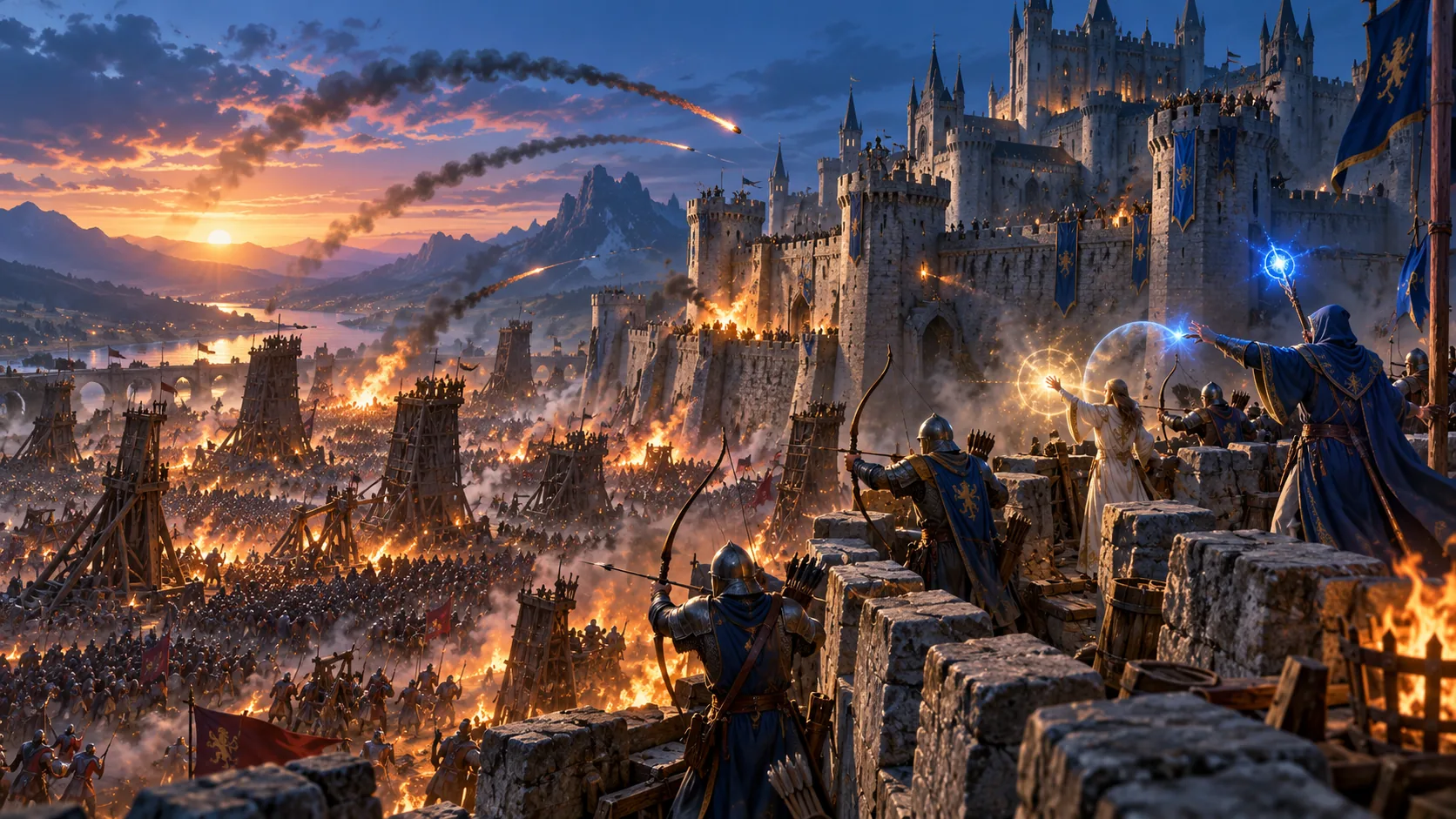
More than 40 traits invite Becastled players to rethink a familiar castle defense. The developer explains why restrictions, new units and changing odds matter.
When a winning plan becomes the problem
Becastled is built around a satisfying loop: grow a settlement by day and defend it against attackers at night. That loop also creates a common strategy-game problem. Once a player discovers a reliable build, they may repeat it across every map. Pingle Studio says it noticed exactly that pattern. Its Traits and Some Magic DLC was designed to give players a reason to reconsider buildings, units, and approaches from one run to the next.
The headline addition is more than 40 traits. They are not simply a pile of bonuses. Many provide a strong benefit paired with a restriction that changes what a sensible plan looks like. The developer's October 22 Xbox Wire explanation is the source for the specific trait and unit examples below. Our discussion of how those choices might affect a run is analysis, not a guarantee about the outcome of every combination.
- 🏰 More than 40 traits can redirect a run.
- 🪄 Mages add fragile area damage.
- ✚ Clerics add healing, with positioning risks.
The one-of-three choice creates a story
The DLC offers a choice of one trait from three options every few days and after a Blood Moon. Traits are grouped into Common, Uncommon, and Rare rarities, with a greater chance of rarer options after a Blood Moon. That schedule matters. It makes traits a recurring strategic event, not a menu that players complete once before the first building is placed.
A choice of three is enough to create tension without asking someone to compare an entire encyclopedia. One option may help immediately, another may support a longer-term plan, and a third may be powerful only if the current map and army can absorb its downside. The right answer can change because the choice arrives at a particular time. A damaged settlement with a thin army values a different perk from one that is already comfortable behind walls.
Rarity adds anticipation, but it should not replace judgment. A rare trait may be exciting, yet a modest economic boost could be more useful if your workers cannot keep up with a planned expansion. The developer does not claim that higher rarity always means the best pick for every run. The system appears designed to make context more important than a fixed ranking.
A bonus with a cost is a real decision
Pingle Studio's clearest example is Master of the Bow, which limits a player to archers while greatly increasing their damage. Glass Cannon increases damage while reducing unit health. Manifest Destiny lowers mood but lets the player acquire several future zones for free. These are not interchangeable small boosts. Each one asks the player to accept a new weakness in exchange for a stronger possibility.
The appeal is that the downside can change the rest of the build. If only archers are allowed, the placement of those archers and the settlement's ability to protect them become central. If mood falls, an expansion plan may need more attention to citizen happiness. If the army's health drops, walls, range, and timing can matter even more. The trait has value partly because it creates a new problem to solve.
The developer says it deliberately avoided making every option pure upside. If all three choices were harmless upgrades, the selection would be less memorable. A trade-off forces a manager to ask whether the current economy, terrain, and army can support the promised power. That is a much richer question than which card shows the biggest number.
Combinations are where a run gets strange
The official post describes Glass Cannon working with Blood Money and Master of the Bow to create archers with very high damage. Another run could produce unusually durable units or a castle with strong ranged offense but no walls. These examples show why a large trait pool matters. The individual selections are useful, but the chain of choices can turn a familiar defense plan into something specific to that run.
A strong combination should still leave the player responsible for execution. High-damage archers may punish attackers quickly, but their reduced health can make one positioning mistake expensive. A build that saves resources on territory might have more land than it can defend. The fun is in managing the new shape of the risk, not merely watching a number climb.
There is also room for discovery without pretending every combination is equally viable. More than 40 traits can produce interactions that are hard for any small team to balance perfectly. Pingle Studio says it used internal playtesting and spreadsheet formulas to examine the possibilities. That is a grounded description of its process; it is not a promise that no overpowered or awkward combination will appear in live play.
Mages turn space into a resource
Traits and Some Magic adds Mages recruited from the new Mage School. The studio describes them as vulnerable units with high impact and area damage. Against groups of enemies, a well-positioned Mage can remove several threats in only a few attacks. Their fragility is the balancing idea. Putting them on walls or behind tougher units can help keep them active long enough to matter.
That addition changes how a player can read the battlefield. A narrow approach may become a good place for area damage, but only if enemies cannot reach the caster too easily. A wall can be both a platform and a liability if it falls while the Mage is exposed. The official overview does not publish damage tables or a universal placement rule. Treat these as tactical questions to test in the game, not a guaranteed formation.
Mages also fit the DLC's wider theme: power that demands protection. A player who takes traits that make units hit harder but die faster may find magic tempting, yet the army could become dangerously brittle. A balanced defense might instead use Mages to support a stable frontline. The interesting choice is not whether magic is strong, but what the rest of the castle must do to make it reliable.
Clerics make survival a positional puzzle
Clerics are the other new unit type from the Mage School. They heal rather than deal damage, and the developer says they were partly motivated by the frustration of losing units during difficult fights. That gives them an obvious role in a run where preserving an experienced army matters. They can extend the life of a defensive line, particularly when paired with Swordsmen according to the studio's example.
But Clerics are fragile. The official article warns that enemy archers and some other units can kill them quickly if they are exposed. Healing therefore is not a free answer to attrition. It is another positioning challenge. Put a Cleric too far forward and the unit disappears before its support matters; hide it too far away and the frontline may fall before help arrives.
This is a useful addition because it gives players a way to think about defense beyond simply building thicker walls. A surviving army can change the next day's economy and the next night's readiness. The healer's contribution may be indirect, but the cost of losing one can be felt across the whole run. As with Mages, the live game is the place to learn precise ranges and behavior.
A small-team system designed to grow
Pingle Studio says it designed the trait framework so designers could create new traits without constantly requiring a programmer. That production decision is connected to the player's experience. A system that is easier to iterate can support more experiments and better revisions. The studio also says some planned ideas were postponed because of time constraints, a realistic limit that helps explain why the released DLC focuses on traits and two new units.
The developer mentions an abandoned or unfinished approach that would have let players select many modifiers before a run, including severe restrictions or removed mechanics. The post is clear that this is not part of the finished DLC. It is useful context for the design direction, but readers should not mistake it for an announced feature they can access now.
The shipped trait system takes the smaller, more legible route. It introduces variation during the run, when the player has already seen the terrain and the state of the settlement. That timing gives a trait meaning. The choice responds to a living castle rather than to an abstract plan drawn up before the first day begins.
How to approach the next run
If you return to Becastled for Traits and Some Magic, start by observing what your usual strategy depends on. Is it a particular wall layout, a preferred unit, or a fast economy? Then, when a trait choice arrives, consider one that changes that dependency. You do not have to choose the strangest option every time. The point is to see what the current run can support and what it asks you to give up.
Pingle Studio has confirmed the DLC and its core systems, but exact balance values can change. Use the current game and official store page for live availability and patch details. The feature's lasting idea is clear: a castle defense becomes more interesting when strength has a shape and a cost. A great trait does not merely make you stronger. It makes you ask a better question before the next night falls.
- Read the restriction before the bonus.
- Protect fragile support units with deliberate placement.
- Let the current map and army influence each trait pick.
CHECK THE ORIGINALS.
Facts and update details above are based on these official sources. Details can change as the game is updated.
- How More Than 40 New Traits Change Your Strategy in Becastled ↗Xbox Wire / Pingle Studio
Loading comments…