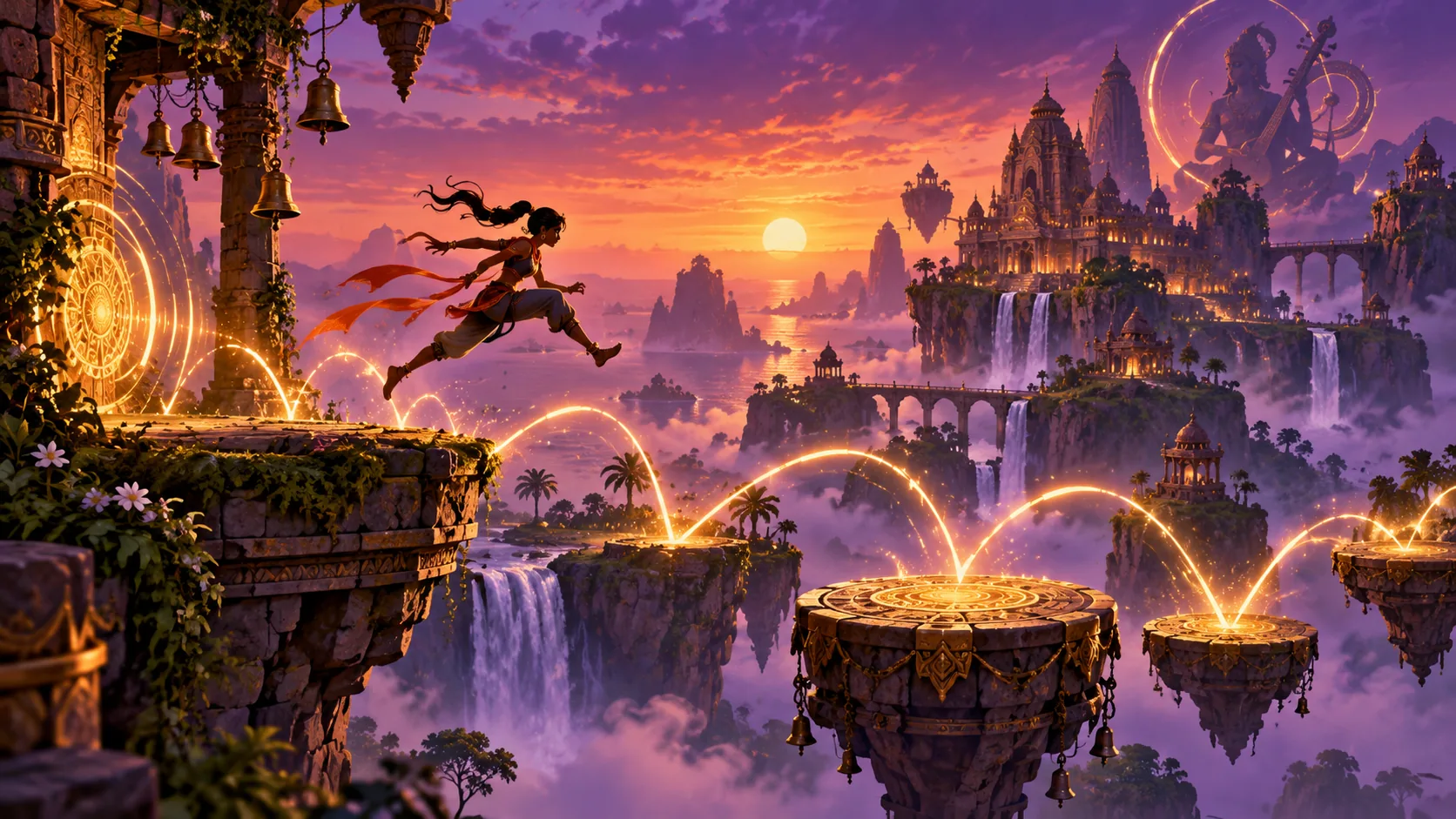
Suri's PS5 debut brings rhythm into movement rather than treating music as background. We look at the design choices behind its jumps, haptics, and Indian-inspired world.
The rhythm is part of the level
Suri: The Seventh Note arrived on PS5 on October 30, 2026, with a premise that sounds simple until you imagine trying to play it: movement and music are connected. Tathvamasi Studios describes a platforming adventure where running, jumping, and phasing are shaped by each level's beat. That turns a familiar action into a timing decision. A jump is no longer only about distance; it is also about when the level expects you to move.
The studio's PlayStation Blog posts are the source for the game's stated mechanics and artistic direction. Our design reading is an interpretation, not a claim that we have measured every level. The interesting question for players is how a game can make timing feel natural without asking everyone to become a musician. Suri's answer appears to be to make rhythm visible, audible, and physical at once.
- 🎵 Music helps set the timing of movement.
- 🎮 DualSense haptics add a physical cue.
- 🌄 The world draws from multiple Indian visual traditions.
Three ways to feel one beat
Rhythm games often give players a lane, a note, and a scoring window. Suri places the rhythm inside a platformer's terrain. According to its developers, environments and movement are built around the music, and the PS5 version uses a Rhythm Haptics Engine developed with the DualSense controller in mind. The controller becomes another channel for timing information rather than a decorative vibration effect.
That can matter when the screen is busy. A player might miss a visual pulse while watching a platform or an enemy. A tactile cue can reinforce the same moment without demanding another glance. It does not guarantee that every missed jump becomes easy to diagnose, and the public material does not publish a detailed accessibility matrix. Still, layering cues is a thoughtful way to teach a rhythm without relying on sound alone.
The developer has discussed a 480 millisecond interval as a balance between responsiveness and musical clarity. That figure belongs to its design explanation, not a universal timing window for every action. It suggests the team considered how long a beat should feel when translated into a character's movement. If the interval were too rigid, travel might feel mechanical; too loose, and the music might seem unrelated to play.
Why a jump can feel like a note
Think about a conventional platformer. You see a gap, judge the run-up, and press jump. The audio may raise tension, but the input decision remains mostly spatial. In Suri, the team says timing is embedded into how the player navigates. The gap is still there, but the beat can become a cue for the exact moment to commit. A successful move may feel less like clearing an obstacle and more like completing a phrase.
That approach changes the way a level can communicate difficulty. A string of platforms can introduce a rhythm, vary it, and then ask the player to recognize the variation. A pause can be meaningful. A sudden acceleration can create urgency without adding another enemy. These are design possibilities inferred from the studio's description; the official posts do not provide a complete list of level patterns or a promise that every stage follows the same structure.
It also suggests a useful way to approach the game. Before chasing a perfect run, spend a short attempt listening and watching for the repeating cue. Notice whether a movement ability belongs on the beat or between beats. If a section defeats you, separate the spatial problem from the timing problem: did you aim at the wrong platform, or did you move at the wrong moment? That distinction can make practice less frustrating.
An island with a cultural point of view
Suri's island is not presented as a generic fantasy backdrop. The studio cites Rajput forts, Theyyam culture, Himalayan monasteries, and other Indian influences in its environment design. It says its characters, animation, and places have been illustrated carefully to give the adventure a distinct identity. Those references matter because rhythm is not only a mechanical system here; it is part of the world's visual and musical language.
A cultural reference should be treated with more care than a checklist of decorative motifs. We cannot judge the full game's representation from preview materials alone. What is clear from the developer's account is that the team wants place, music, and motion to support one another. An architectural silhouette can set the mood before a note plays; a color shift can make a new passage feel different; a cutscene can introduce an instrument before it becomes part of play.
The studio also describes mixing Indian textures with a bouncy, stripped-back musical style. It has explained that the exact rhythm needed for play shaped its choices, so a strictly traditional arrangement would not always fit a responsive platformer. That is a design constraint, not a value judgment about the music it draws from. The result aims to keep a sense of place while leaving enough room for the player to read the beat.
Haptics can teach without a tutorial box
The DualSense angle is easy to reduce to a feature badge, but the more interesting role is teaching. If the controller's pulse aligns with an important movement moment, the player's hands receive an example before the game needs to explain the rule in text. Over several attempts, that signal can become part of muscle memory. The developers' earlier gameplay reveal explicitly ties Suri's Rhythm Haptics Engine to PS5 feedback.
There are limits to what we can conclude. The public material does not show how every accessibility setting changes the experience, whether vibration can be customized in-game, or how the game behaves with every supported controller configuration. Players who rely on a particular input setup should check the current PlayStation Store listing and in-game settings. A promising feature deserves careful description, especially when it may affect how comfortable a game feels.
The broader design lesson is that feedback works best when it carries information. A controller buzz that simply repeats an explosion is atmosphere. A pulse that helps you identify the next safe move can become an interface. Suri appears interested in that second role. The outcome will depend on whether its cues remain consistent enough to learn while still leaving room for surprise.
The challenge is pacing, not just speed
A rhythm platformer can be demanding without being relentless. Suri's official description talks about hidden paths, movement abilities, and exploring its island as well as chasing clean runs. That mix suggests different tempos: an intense sequence that tests timing, then a calmer stretch where the player notices the environment. Those shifts can help the music feel like part of a journey instead of an endless metronome.
For a newcomer, the temptation may be to sprint through a level as soon as a beat becomes familiar. Slowing down first can reveal how a cue relates to a platform, and whether a power such as phasing changes the route. A player who only wants to explore may find value in learning the rhythm as a navigation aid rather than as a score chase. The studio has not said that every hidden path is rhythm-gated, so that remains a question for hands-on play.
This is where Suri can stand out among PS5 platformers. Many games use music to reward a successful action after it happens. Here, the music is positioned to help decide the action before it happens. When those two moments line up, the world can briefly feel like an instrument that answers the player.
Who should pay attention?
Players who like precision platformers, music-led games, or unusual uses of the DualSense have the clearest reason to look at Suri. The official material also presents a colorful fantasy world and a story around Ajira's journey, so the appeal is not limited to people who chase perfect timing. If your interest is in Indian-inspired game art, the developer's own explanation of its references makes the project worth following closely.
If you are deciding whether to buy, use the current PlayStation Store page for price, editions, regional availability, and accessibility information. The launch blog discussed a Standard and Digital Deluxe Edition and a preorder discount, but promotional terms can expire. This feature focuses on the design rather than repeating time-limited offers as if they were still active.
The most useful first-session goal is small: identify one visual beat cue, one sound cue, and one haptic cue, then see whether they describe the same moment. If they do, the game's central idea will be clear without a complicated explanation. If they do not, the early levels still give you a practical way to discover which cue helps you most.
- Start by listening for the repeating phrase.
- Watch the platform movement before increasing speed.
- Check controller and accessibility options in the live game.
A platformer you may feel in your hands
Suri: The Seventh Note is interesting because its music, visual identity, and controller feedback are aimed at the same design problem: how to make movement feel musical. The developer's posts confirm a rhythm-focused PS5 platformer with a distinctive island and a dedicated haptics system. Whether every level fulfills that promise is something only extended play can answer.
For now, the official details justify a closer look. The game does not need to invent a new button to feel different. It can change the meaning of an old one. When a jump becomes a response to a beat, a familiar platforming action can carry a whole new kind of anticipation.
CHECK THE ORIGINALS.
Facts and update details above are based on these official sources. Details can change as the game is updated.
- Suri: The Seventh Note launches Oct 30 on PS5 ↗PlayStation Blog / Tathvamasi Studios
- Suri: The Seventh Note PS5 gameplay revealed ↗PlayStation Blog / Tathvamasi Studios
Loading comments…