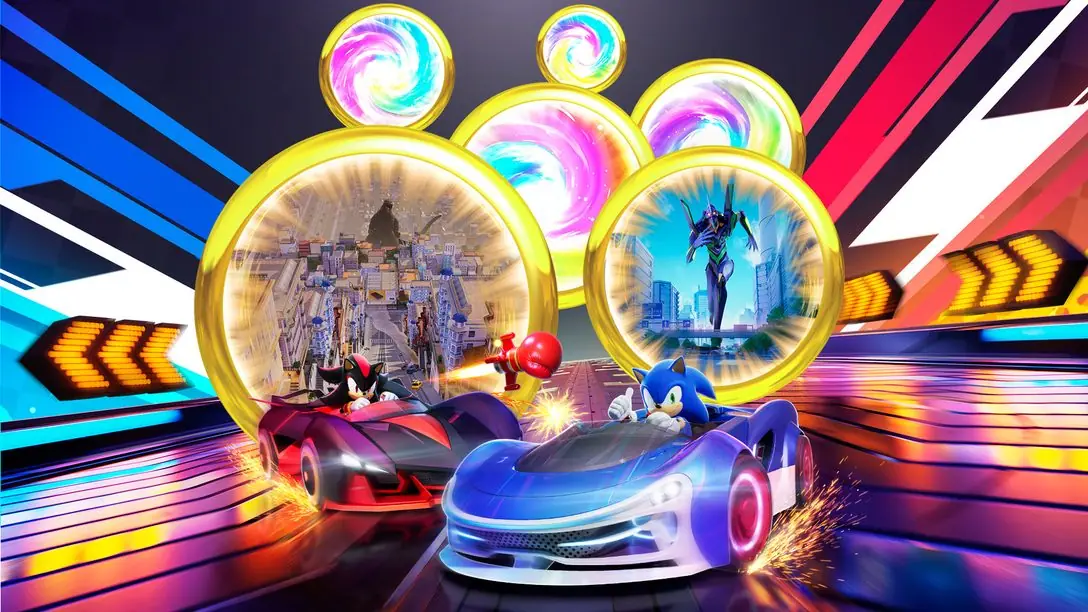
SEGA's Year Two update changes more than the roster: Duel Mode turns racing into a one-on-one contest, while Super Slot strengthens a chosen one-slot Gadget. Here's the practical impact and the limits of what is confirmed.
What changed in Sonic Racing: CrossWorlds Year Two?
Sonic Racing: CrossWorlds Year Two began rolling out on November 3, 2026, according to a SEGA developer interview published by PlayStation Blog. The two most consequential gameplay additions are Duel Mode, a one-on-one race format, and the Super Slot, which boosts the effect of a selected one-slot Gadget. SEGA also describes more racers, vehicles and courses, plus a Sega Consoles Pack with hardware-inspired rides.
Those are confirmed additions, but the interview is not a numerical patch sheet. It does not provide a full character list, course schedule, Gadget multipliers, ranked restrictions or platform-by-platform rollout times. We reviewed the official explanation and have not performed a hands-on playtest. Where we discuss strategy below, we are drawing a reasoned inference from the stated rules, not reporting measured performance.
- Duel Mode: one racer against one racer instead of the familiar 12-player field.
- Super Slot: one-slot Gadget effects are enhanced when equipped in the dedicated slot.
- Sega Consoles Pack: three vehicles draw from Dreamcast, Genesis and Sega Saturn hardware.
- Availability details, exact tuning and mode-specific rules should be checked in the live game.
Duel Mode changes which decisions matter
A busy 12-player lobby can hide a costly mistake. You may lose places in traffic, gain them back with an item chain, then finish near the middle without understanding the original error. A duel is a cleaner feedback loop: you can watch the gap to a single rival and ask whether your route, item timing or vehicle choice changed it. SEGA explicitly says distance management and item use are central to the new format.
That could make Duel Mode useful for practice as well as competition. If you fall behind at the same portal transition each time, that is a better clue than an overall finishing position in a crowded race. If the gap changes only when an item is spent, you have a timing problem to examine. We would start with the same rival or comparable conditions for a few races, changing one decision at a time where the mode allows it.
Do not read 'one-on-one' as a promise of a completely isolated time trial. SEGA has not published every rule in the interview, including how queues, tracks, items or ties are handled. Check the mode screen after installing the update before assuming a tournament format or claiming a particular build is dominant.
- Watch the gap after each major route choice, not only at the finish line.
- Record the moment you use an item and whether it actually closes the distance.
- Repeat a route before changing Gadgets; otherwise you cannot tell what caused the improvement.
- If a duel feels uneven, compare track familiarity and mistakes before blaming balance.
The Super Slot makes Gadget choice a sharper trade-off
SEGA says Year Two introduces a dedicated Super Slot for one-slot Gadgets, and the Gadget placed there gets an enhanced effect. That sounds simple, but it shifts the question from 'which Gadgets fit?' to 'which single effect deserves the boost?' A favorite Gadget may be reliable in a large lobby yet deliver little value against one opponent; another may be modest in a crowd but useful whenever you need to defend a lead.
Our practical read is to choose the Super Slot around a problem you can observe. If you repeatedly lose position after a portal, focus on consistency before chasing the biggest theoretical bonus. If you routinely catch up but cannot hold a lead, test a tool that supports the last part of the race. These are testing ideas, not claims that a specific unnamed Gadget has been buffed by a specific amount.
We would avoid a day-one 'best Super Slot' ranking until the live item descriptions and repeated matches show how much each effect changes. The interview confirms an enhancement, but not its numerical strength, stacking behavior or restrictions. A setup that wins one duel may also be weak in a full field, because the racing problems are different.
- Start with a one-slot Gadget you already understand.
- Run several races without changing the rest of your setup.
- Compare a clear outcome: gap at a checkpoint, item survival, or consistency through a portal.
- Swap only the Super Slot Gadget, then repeat before making a broader build claim.
The Sega Consoles Pack is a design story, not a confirmed speed advantage
The Dreamcast, Genesis and Sega Saturn vehicles are more than small logo swaps. The developers say they converted hardware shapes into racing bodywork: rounded console forms became fenders and nose sections, while angular designs informed panels and hoods. They even recreated Dreamcast's Visual Memory Unit from original reference data. The Genesis Tower US design needed extra work so its silhouette would not obscure the driver or interfere with gameplay.
That attention to visibility is the interesting gameplay-adjacent detail. A flashy body is fun until it blocks your view of a corner or an item. SEGA's comment suggests the team was aware of that risk, but it is not a published visibility benchmark. If you buy or unlock a console-inspired vehicle, judge it in motion at the camera angle you actually use. Do not assume its performance is superior because the pack is positioned as a bonus.
The PlayStation Blog identifies the Sega Consoles Pack as an exclusive bonus associated with the Year Two Digital Deluxe Edition and Season Pass Two. Check the current store description for your platform, region and edition before spending. Store bundles and entitlements can differ, and the developer interview does not establish a universal price for every market.
- Dreamcast: rounded shape and VMU-inspired detail.
- Genesis: angular silhouette, including the experimental Genesis Tower US design.
- Sega Saturn: another angular hardware reference in the three-vehicle collection.
- Pack entitlement: verify your edition and region in your platform's live store.
What Year Two could do to the racing meta
The strongest potential change is not simply adding more content. It is that a dedicated duel exposes how much of a player's success comes from routing and item judgment when a crowded field no longer absorbs every error. If many players begin comparing one-on-one results, community advice may become more specific: a Gadget could be described as strong in duels, useful in 12-player races, or merely comfortable for a certain track. That is our analysis of the design, not a claim that a stable competitive meta already exists.
The Super Slot can also make build discussion more useful if players share conditions. 'This setup won' tells you little. 'I used this one-slot Gadget in the enhanced slot, held the same route and improved my gap at the final transition over several races' is a reproducible observation. The distinction matters for a live racer where new characters, vehicles, courses and balance decisions can change the answer later.
For casual players, the update may be valuable even without a competitive ladder. A friend can give you an immediate benchmark in Duel Mode, and the Super Slot offers a small, understandable experiment to try after a race. A player who has bounced off chaotic full lobbies may find that easier to learn from. Whether that feeling holds up depends on the final rules and your own matches.
What to check before you race or buy
Install the current Year Two update through your platform's official game client, then inspect the live mode and Gadget descriptions. The November 3 interview is reliable for the design intent and named additions; it is not a substitute for exact patch values. If a menu or store page conflicts with an older announcement, record the platform, region and date before sharing a claim.
For a first session, we would try a familiar vehicle and Gadget setup in the standard format, then take that same setup into Duel Mode. Once the format feels clear, move one Gadget into the Super Slot and compare results. This keeps the experiment small enough that you can actually learn from it. We have not played this update ourselves, so treat this as a reader practice plan rather than a firsthand performance verdict.
SEGA's PlayStation Blog interview also mentions a permanent US price reduction for the PlayStation versions, with Standard at $39.99 and Digital Deluxe options at $59.99 at publication. Prices, taxes and bundles vary by region and can change. The live store is the right place to decide whether an edition or pass is worth buying, especially if you only want the new racing mechanics.
- Confirm that Duel Mode appears in your current game menu.
- Read the in-game Super Slot description before comparing Gadget effects.
- Check platform, region and edition for the Sega Consoles Pack entitlement.
- Use the official store for current prices rather than an old article screenshot.
FAQ
What is Duel Mode in Sonic Racing: CrossWorlds Year Two?
SEGA describes it as a one-on-one racing mode that puts more emphasis on the gap to your opponent and on item use than a standard 12-player race. Specific matchmaking rules were not detailed in the November 3 developer interview.
How does the Super Slot work?
The developer says it is a dedicated slot for a one-slot Gadget. Placing a Gadget there enhances its effect. The interview does not give a complete list of enhanced values or a universal best choice.
Which Sega consoles inspired the new vehicles?
The Sega Consoles Pack includes vehicles inspired by Dreamcast, Genesis and Sega Saturn. SEGA says the shapes and colors reference the original hardware, including Dreamcast's VMU.
CHECK THE ORIGINALS.
Facts and update details above are based on these official sources. Details can change as the game is updated.
- Sonic Racing: CrossWorlds Year Two developer interview ↗SEGA via PlayStation Blog
- Sonic Racing: CrossWorlds PlayStation product listing ↗PlayStation Store
Loading comments…