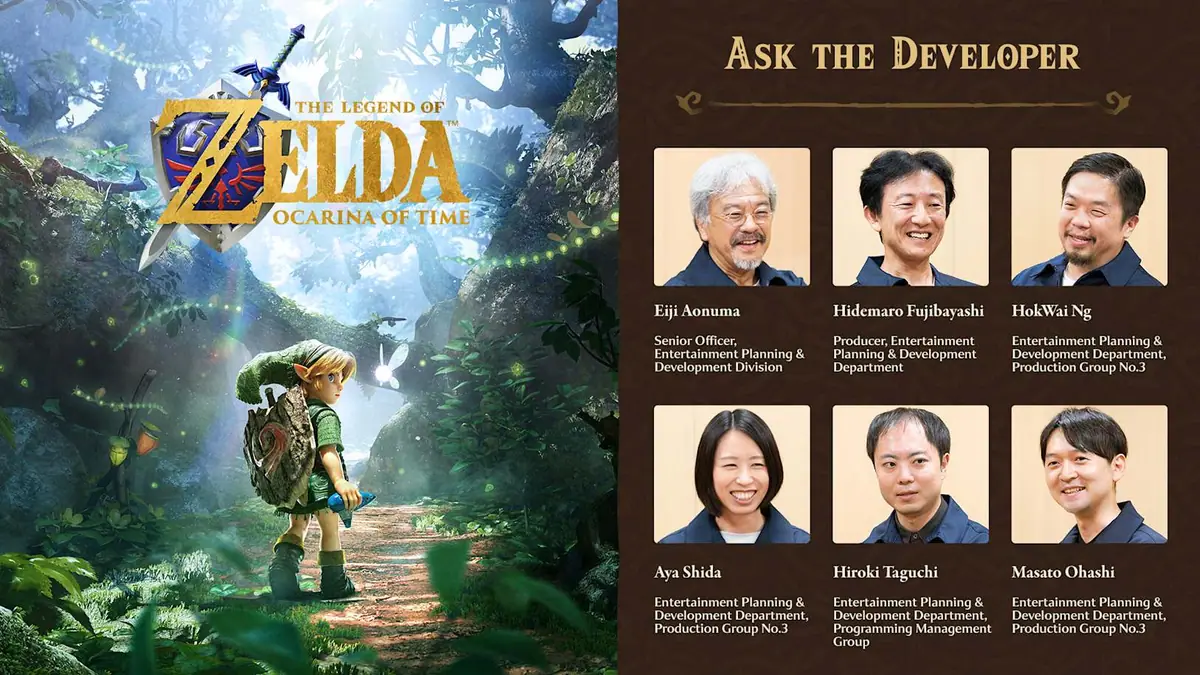
Nintendo's new developer interview explains how the Ocarina of Time remake changes movement, dungeons and sound while keeping the original adventure's structure. Here are the details that matter before launch.
Nintendo's new interview confirms a full remake, not a simple visual upgrade
The Legend of Zelda: Ocarina of Time is scheduled to launch for Nintendo Switch 2 on November 5, 2026. Nintendo's four-part Ask the Developer interview, published just before release, says the team rebuilt the game from scratch. The aim was to keep its carefully paced adventure while changing controls, camera, presentation and some frustrating points of navigation. We checked Nintendo's interview and product page rather than treating a trailer montage as a complete feature list.
The most revealing decision is one players will never see: producer Eiji Aonuma requested new warp points, tried them, then removed them because skipping travel also skipped small discoveries along the way. That choice explains the whole remake better than a resolution comparison. Nintendo is modernizing what a player can do moment to moment without converting Ocarina into the free-form structure of Breath of the Wild.
We have not played the release build. Below, we separate developer statements from our analysis. Verdicts on performance, pacing and puzzles must wait for the shipped game.
- Release: November 5, 2026, for Nintendo Switch 2, according to Nintendo's store.
- Build: a full remake created from scratch, according to the development team.
- Confirmed changes: manual jump, updated camera, easier Water Temple navigation, new audio and expanded story presentation.
- Core intent: preserve the original's discovery-led progression rather than replace its structure.
Free jumping and two Jump Attack methods change how Link feels
The original game used auto-jump at specific ledges. Director HokWai Ng says the remake removes that restriction and lets players jump with a button. That sounds like a small comfort feature until you consider dungeon design: spaces originally built around fixed jump points now need to account for players trying to cross gaps from unexpected angles. The developers say Young Link and Adult Link jump slightly different distances, making terrain tuning even more delicate.
Nintendo also confirmed two ways to perform a Jump Attack. Players familiar with the Nintendo 64 game can use a single-button method, while those used to newer Zelda controls can jump and then attack. A held Roll Attack button can trigger a dash, while repeated rolls remain possible. These are options described by the developers, not an invented settings menu or control diagram.
Our reading: the team is trying to lower input friction without removing the old rhythm. For a returning player, a familiar attack input can preserve muscle memory. For someone arriving from Tears of the Kingdom, a jump button may prevent the opening hour from feeling oddly restrictive. The real measure will be whether level boundaries and puzzle solutions still communicate clearly once players can move more freely.
- Original: automatic jumps at defined locations; remake: player-controlled jump.
- Jump Attack: legacy single-button route and newer jump-then-attack route are both supported.
- Travel: repeated forward rolls remain, with a hold-to-dash option added.
- Caveat: Nintendo has not supplied a full controller mapping in the cited interview.
The Water Temple fixes focus on readable space
Aonuma says he wanted to revisit the Water Temple, a dungeon he helped design for the original. The interview describes repeated menu use and disorientation underwater as the problems the team addressed. The remake makes item toggling easier and changes some walls to lattice structures, letting players see rooms beyond them and understand how spaces connect.
Director Ng says the dungeon mechanisms were broadly kept, with smaller placement changes that guide players more intuitively. The first boss, Gohma, is another example of clearer communication: when it cannot be damaged, it now guards its weak point with its arms. The attack timing still matters, but the visual state tells a player more about why an attempt failed.
That distinction matters for any remake of a famous puzzle game. A clearer clue can reduce time lost to interface friction without handing out the answer. A completely redesigned room could alter the puzzle itself. Nintendo's examples point mainly to readability, but we will need to play the final game before claiming every Water Temple challenge survives unchanged.
A modern camera creates a new navigation problem
The Nintendo 64 version relied on a camera and targeting system designed around one control stick. Nintendo says the Switch 2 remake allows freer camera movement. That lets players inspect the rebuilt world from more angles, but it also changes how they maintain direction after a door opens or a fight ends. A camera improvement can accidentally make an old room harder to read if its original composition assumed a fixed viewpoint.
The team says it adjusted the environment to help players understand where to go. In some places, objects have moved slightly without changing the underlying dungeon mechanism. This is an unusually useful developer admission: preserving the feel of an older game may require changing details that once guided the eye invisibly.
We would watch for two things when the remake launches. Can a newcomer identify the next path without consulting an external guide? Can a returning player still recognize a room even where visual cues have shifted? Those questions are more revealing than a side-by-side texture comparison, because Zelda's dungeons depend on spatial understanding as much as scenery.
The art direction avoids turning Hyrule into generic realism
Art director Aya Shida describes a dense, believable Hyrule that still preserves the original's dreamlike contrast between dark spaces and colorful characters. The team explored an analog, puppet-show feel rather than a literal photorealistic translation. Shida says they researched real materials, including fabric, while rebuilding character clothes and world details.
The design challenge is visible even before release: detailed modern graphics can expose exaggerations that worked perfectly on Nintendo 64 but look strange when copied one-to-one. Nintendo's artists therefore treated familiar silhouettes and character presence as the anchor, while redesigning surfaces and animation for new hardware. That is their stated approach, not a claim that every fan will prefer the result.
Our angle is that fidelity should be judged by recognition and function, not polygon count alone. Does Kokiri Forest still feel mysterious? Do characters remain distinct from a distance? Does a clue stand out in a busy room? The team's own comments suggest it knows that a beautiful environment can weaken a puzzle if it hides the information the original made obvious.
More than 150 tracks, voiced scenes and a microphone-powered ocarina
Sound director Masato Ohashi says the remake contains more than 150 pieces of background music, including new material for expanded cutscenes. Grand themes use full orchestral force, while simpler spaces keep restrained instrumentation. The team recreated some sounds using the Nintendo 64 source as reference and recorded a real ocarina. Nintendo also confirms 5.1-channel surround support.
The ocarina has a new input option: players can hum or play an instrument into the Switch 2 microphone and have the game recognize a learned song. Standard button controls remain available. Aonuma explicitly says the voice feature is not meant to make progression easier; it is another way to feel close to the world. We would treat it as an optional interaction, not the new required solution to every song puzzle.
Cutscenes are fully voiced, but the developers were careful with established character sounds. Nintendo says Japanese auditions hid actor names so casting focused on whether a voice fit the original impression. The creative risk here is different from a graphical overhaul: a voice can overwrite a sound a player has carried in memory for decades. That is why the interview spends so much time on familiar audio motifs.
- Music: more than 150 background pieces, according to Nintendo's sound director.
- Ocarina: traditional buttons or microphone input for humming and instruments.
- Presentation: voiced cutscenes and expanded ambient sound; 5.1 surround is supported.
- Player choice: the microphone feature is optional, based on Nintendo's description.
Why the removed warp points may be the most important news
Aonuma's rejected shortcut idea ties the announced changes together. Adding fast travel would have saved time, but the team found that it removed chance encounters and moments of curiosity during journeys across Hyrule. Nintendo chose to keep the travel structure even while adding a dash. That is not stubborn nostalgia; it is an editorial choice about what makes the adventure work.
The same principle appears in the Water Temple and Gohma examples. They make feedback clearer while keeping the fundamental challenge. New jumping, voice input and camera control widen player agency, but the story still moves through a paced sequence rather than an open-air world. For newcomers raised on Breath of the Wild, this could be a useful introduction to a different Zelda rhythm. For veterans, the question is whether familiar discoveries still happen naturally.
Nintendo lists the remake for November 5 on Switch 2. Until release, we cannot report firsthand frame rate, puzzle flow or control comfort. The team rebuilt a landmark game, tested modern conveniences, and discarded one because it weakened exploration. That is a stronger reason to watch this launch than prettier graphics alone.
FAQ
When does the Ocarina of Time remake release?
Nintendo lists The Legend of Zelda: Ocarina of Time for November 5, 2026, exclusively on Nintendo Switch 2. Check your regional store for the local unlock time.
Is the Switch 2 Ocarina of Time a remaster or a remake?
Nintendo calls it a full remake. Its developers say they rebuilt the game from scratch while preserving the original adventure's structure and feel.
What changed in the Water Temple?
Nintendo's developers say item toggling is easier and some walls now use lattice structures so players can see rooms beyond them. The core dungeon mechanisms are broadly retained.
CHECK THE ORIGINALS.
Facts and update details above are based on these official sources. Details can change as the game is updated.
Loading comments…