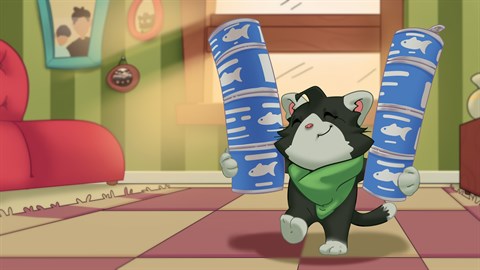
Sneaky Purr is a compact puzzle game with a deceptively important rule: Bill keeps sliding until he hits something. This beginner guide explains how to read a board, plan the food-pouch route and escape, and use the game’s tools to learn from a failed move.
Learn the one rule that changes every move
Sneaky Purr launches on Xbox Series X|S on October 27, 2026. You guide Bill, a cat thief, through compact levels where he must collect food pouches and return to the exit. The defining rule is simple: choose one of four directions, and Bill keeps sliding until he hits an obstacle. A move is therefore a route decision, not a single step.
That rule changes how you read a room. A wall is not only a boundary; it can be a safe stopping point. A camera is not only a hazard; its position can determine when you are allowed to cross a lane. Before moving, trace the whole slide in your head and ask where Bill will stop. If you cannot answer, wait and inspect the board again.
The Xbox store lists 30 levels across three biomes and says there is no time pressure. That gives you room to plan instead of rushing. This guide focuses on the rules Afil Games has confirmed, plus practical puzzle-solving habits. It does not assume a specific solution for any level, because board layouts and obstacle positions determine the route.
Read the board before you chase the first pouch
Start each level by locating four things: Bill, every food pouch, the exit, and obstacles that can stop or redirect movement. Then identify camera sight lines and any barriers that might change after you pass a point. The Xbox description confirms cameras rotate as you move and that some obstacles can block paths or redirect Bill, so the board may change while you act.
Next, connect the pouch locations to the exit rather than treating them as separate errands. A route that reaches the food but leaves Bill stranded on the far side is only half a solution. Look for a way to make each stop useful twice: an obstacle might collect a pouch and then place Bill where he can begin the return journey.
Do not try to solve the entire level with a single vague plan. Break it into checkpoints: reach the first useful stopping point, cross a camera lane, collect an item, then assess the new board. This keeps the reasoning manageable. If a barrier changes after a trigger, pause again and plan from the changed state rather than following a route that no longer exists.
Treat camera timing as part of the route
The Xbox listing says security cameras rotate as you move. That means your action can change both Bill’s position and the threat facing him. Before entering a visible lane, check which way a camera points and what its likely movement means for the next slide. Plan a stopping point that leaves you behind cover or outside the camera’s path when possible.
A common puzzle mistake is focusing on the pouch while ignoring the return. Ask whether the move that collects it will leave Bill exposed, and whether the next action can safely reposition him. A short route is not always the safest route. If a detour places an obstacle between Bill and a camera, the extra movement may be worth it.
Because the game has no time pressure, use observation instead of guessing. Watch what moves after each action and update your mental map. If you are uncertain whether a camera has rotated or an obstacle has activated, inspect the board before making another move. A calm second look is cheaper than repeating a long sequence from the beginning.
Use obstacles as tools, not decorations
Walls and objects determine where Bill stops, but the store page also mentions obstacles that can block routes or automatically redirect movement. That makes the environment part of the puzzle’s control system. A surface or barrier may create a reliable stopping point, while another may send Bill in a direction you did not intend. Read the object’s position before committing to a long slide.
When you encounter a new obstacle, test what it does in a low-risk way. A single move can reveal whether it stops, redirects, or changes after Bill passes a trigger. Keep track of what changed immediately afterward. This is a practical way to learn a level’s rules without assuming every object behaves like a familiar puzzle-game mechanic.
If a route suddenly becomes blocked, do not force the original plan. Look for another way to reach the same stopping point, or use a redirecting object to approach from a different side. The goal is to reason from the board you have now. A changed obstacle can feel like a setback, but it may also create a new route to the exit.
Use Undo and Restart to learn without overthinking
Afil Games lists Undo and Restart as tools for experimenting. Use Undo when you want to inspect the result of one move without accepting it as part of the final route. Restart is useful when the board state has become hard to track or when you want to compare a cleaner plan from the beginning. These options make trial and error a normal part of the puzzle loop.
Try changing one decision at a time. If Bill gets caught, undo the last move and ask what information you missed: the camera direction, the destination after a slide, or a barrier’s reaction. If you change several earlier moves at once, it becomes harder to understand what actually fixed the problem. Small experiments build a better mental model for later levels.
Do not treat an undo as proof that you made a bad move. Sometimes a move is useful precisely because it teaches you how the room behaves. The key is to make the information stick. Before trying again, state the lesson in plain language: ‘this lane is watched after the first pouch,’ or ‘that object redirects Bill upward.’ Then use the new knowledge to build a more reliable route.
A reliable route-planning checklist
Before your first move, identify the exit and mark which pouch is hardest to reach. Trace a complete path to that pouch and back, even if you later change the order. Look for stopping points that let Bill turn without needing precise timing, and note any camera whose direction changes after a move. This quick scan catches many mistakes before they cost a full attempt.
During the route, pause after each major change. Confirm where Bill stopped, whether the camera moved, and whether any barrier changed the map. Keep the return route in mind after every pickup. If the board now makes the exit unreachable, use Undo or Restart and reorder the pouches rather than repeating a route that cannot finish.
Sneaky Purr is built around thoughtful, bite-sized decisions, not speed. Let each level show you how its objects work, use the retry tools as intended, and treat the walk back as part of the puzzle from the very beginning. Once you consistently plan both directions, the sliding rule becomes less like a trap and more like the game’s central language.
FAQ
How does movement work in Sneaky Purr?
The official Xbox description says Bill moves in four directions and keeps sliding until he hits an obstacle.
Does Sneaky Purr have a timer?
The Xbox store describes 30 levels across three biomes with no time pressure.
Can I retry a bad move?
The game listing says you can use Undo or Restart to try another route.
CHECK THE ORIGINALS.
Facts and update details above are based on these official sources. Details can change as the game is updated.
Loading comments…