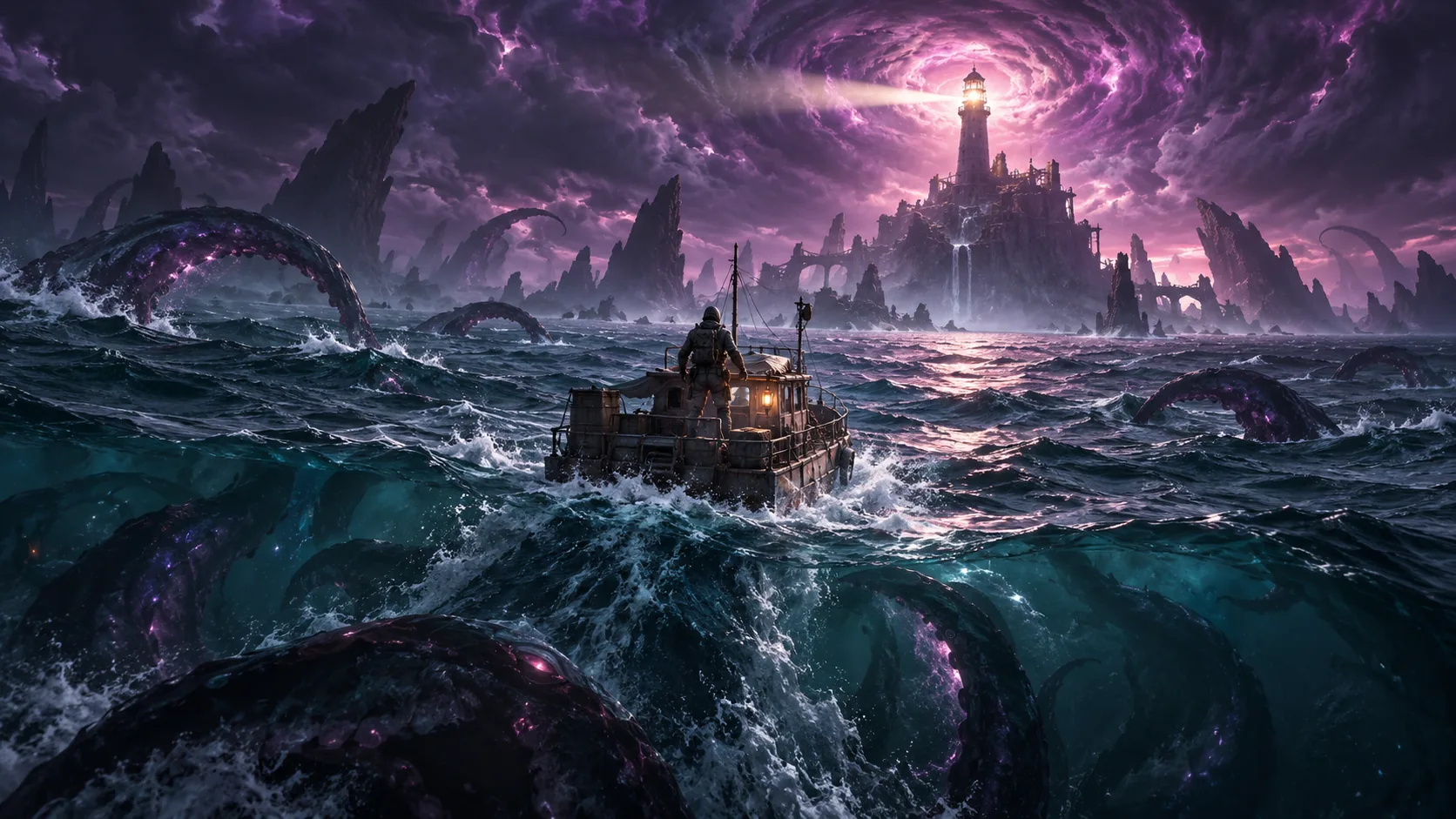
The sea is more than a route between islands. Use this beginner plan to prepare a ship, manage resources, and approach the expansion's stranger encounters without rushing blind.
Before you leave the shore
Once Human's free Isles of Abyss expansion turns the ocean into a survival space rather than a loading screen between islands. The development team describes five marine sectors, each with a different environmental crisis. Ships can be customized from lean skiffs to large floating fortresses, and the loop stretches across open water, islands, and the seabed. That makes the first decision less about sailing fast and more about whether you can return safely.
This guide uses the team's official October 29 explanation and the accompanying Xbox bundle description. It does not assume a secret best route or an exact resource count, because those details vary by your progression and current build. The practical goal is to give a new crew a repeatable preparation loop: plan, leave port, gather, and come home with enough supplies to improve the next trip.
- 🚢 Build a ship for the trip you intend to make.
- 💧 Carry water and diving supplies before going deep.
- 🗺️ Treat each marine sector as a new survival problem.
Give your ship a job before adding parts
The studio says ships can serve as mobile sanctuaries, workshops, diving platforms, and artillery batteries. That is a lot to ask from one hull. Before placing every upgrade you can afford, decide what your next voyage is for. A scouting trip needs speed, visibility, and a safe return path. A materials run needs storage and a way to repair. A fight against a heavily defended target may justify stronger weapons and a crew ready to use them.
The official examples include fast skiffs that avoid anomalies and bigger vessels with heavy cannons, crafting benches, and diving rigs. Those are different answers to the same sea. A beginner can copy the logic without copying a fixed blueprint: choose the threat you expect to face, then fit the vessel around it. If you have not seen a sector yet, favor flexibility and an easy escape over a huge but expensive project.
Do a short shakedown sail close to safety. Check how the deck works when people move, where you store basic supplies, and whether a diving return is easy to manage. That is general gameplay advice drawn from the modular-building premise, not a claim that the game requires a formal ship inspection. A cheap mistake near shore is easier to absorb than one made during a long trip.
Pack for water, wounds, and a longer trip
The official Xbox bonus pack lists purified water, a compact water filter, a basic diving suit, and antibiotics as an ocean survival supply bag. Those items are a useful clue to the kind of pressure the expansion expects, even if you do not claim the pack. Bring water and a way to handle the conditions your planned route may create. Check your current inventory, storage space, and crafting options before you board.
The developer describes sectors that can strip away your vision, sense of direction, stable footing, gear, or sanity. The exact hazard is not identical everywhere, so a generic combat loadout is unlikely to solve every problem. Build a small reserve and leave room for whatever you find. If your bag is completely full at departure, a rare seabed component or ghost-ship reward becomes a difficult choice instead of a useful find.
One simple habit is to define a turn-back point before departure. If a critical supply falls below that level, return to a safe area and restock. The official post does not state a universal number, and this article will not invent one. The value is the decision rule itself: it prevents a crew from stretching one more objective into a failed voyage because the next island looked close.
Read each sector before committing
Once Human's designers say each of the five marine sectors forces a shift in survival protocol. That means an approach that worked in one region may become a trap in another. As you enter a new sector, slow down, observe the environmental behavior, and identify what is being taken from you. Is navigation harder? Are you losing a dependable resource? Does the area make the vessel vulnerable? Answering those questions is more useful than repeating the previous route at full speed.
The expansion also uses anomalous lighthouses and drifting ghost ships as part of its horror language. A lighthouse that would normally promise safety may instead suggest danger. A ghost ship may hold rare loot, according to the Xbox bundle description, but it is still a deliberate risk. Treat each encounter as a choice. Are you equipped to board and leave, or are you gambling your return trip for one chest?
Keep a route simple until you understand a sector. Visit one point of interest, note what changed, and return. Then expand. This is a suggested learning method, not a scripted progression path. It works because the game asks you to coordinate survival across different spaces, and information is often as valuable as an extra weapon.
Sea, island, seabed: one loop, three risks
The developers describe an interconnected loop of sailing across open water, exploring islands, and diving to the seabed for rare components. Think of these as stages of one expedition. If the ship arrives damaged, the island leg begins under pressure. If the crew uses every supply on land, the dive becomes a poor bet. And if the dive consumes the last safe margin, the journey home may be the hardest part.
A practical run can start with a modest objective in each layer. Reach a nearby region, explore a limited area, and make one short dive. Return, craft or repair, then decide whether the next trip should go farther. The official material supports the existence of the three-layer loop, while this staged route is editorial advice. It helps players learn the expansion's systems without pretending that every server or group has the same optimal path.
If you play with friends, assign responsibilities before something attacks. One player can watch navigation, another can monitor the ship and supplies, and another can prepare for combat or diving. Roles can rotate. The aim is simply to avoid the moment when everyone assumes someone else has the water, repair materials, or route back.
Choose a goal that fits your crew
The official bundle description names Towers of Calamity as progression targets that unlock new technology. Ghost ships offer loot, and a server-wide effort can trigger a four-player co-op raid against the Sunken Lord. Those are not all first-hour objectives. A new crew should first learn how to make a successful return journey. When that feels reliable, the larger goals become less intimidating and more meaningful.
The Sunken Lord is described as more than a distant target for ship artillery. The development team says the encounter involves moving through its outer defenses and into its body. That is a clear reason to avoid treating the eventual raid like an ordinary naval fight. Build experience with movement, resources, and group coordination before making it the focus of your evening.
Progression can become easier to plan when you separate equipment goals from experience goals. A technology unlock can improve the ship, while a careful exploratory run improves the crew. Both matter. If a raid fails, ask whether the issue was gear, route knowledge, or teamwork before rebuilding everything from scratch.
A note on launch bundles and changing availability
Xbox Wire says Game Pass Ultimate members could claim an Isles of Abyss launch bundle through the Perks gallery until November 18, 2026. The bundle description lists water, a filter, diving gear, antibiotics, Starchrom, and a choice of one Morphed Deviation, with a one-claim limit across platforms. Those terms are time-sensitive. Check the live Perks page and your region rather than assuming an old promotion is still active.
The expansion itself is described as free and available on Xbox Series X|S, with cross-play noted in the official bundle description. Store listings and service terms can change, so confirm the current platform version before inviting a group. Nothing in this guide requires a paid bundle. A player can use the same preparation principles while collecting supplies through ordinary play.
Promotional supplies are helpful, but they should not become a substitute for understanding the survival loop. A compact water filter is useful because the ocean can become a long journey. The important lesson is to plan water access and the return route before you need them, whether an item came from a perk, crafting, or a teammate.
The first successful voyage is the real win
Isles of Abyss has enough spectacle to pull players toward the horizon, but the best beginner move is small: build a purposeful ship, pack for the sector, learn one route, and come back. Once Human's official team confirms a living ocean, modular vessels, five distinct sectors, ghost ships, deep-sea resources, and the Sunken Lord raid. Those details support an adventure that rewards preparation as much as bravery.
Do not be surprised if a clever ship design changes after one rough trip. That is the point of a modular survival game. A voyage teaches what your crew lacks, and the next build answers that question. The sea may be watching, but you still get to decide when to leave shore and when to turn around.
CHECK THE ORIGINALS.
Facts and update details above are based on these official sources. Details can change as the game is updated.
- Once Human: From A Misplaced Lighthouse to the Living Ocean of Isles of Abyss ↗Xbox Wire / Once Human development team
Loading comments…