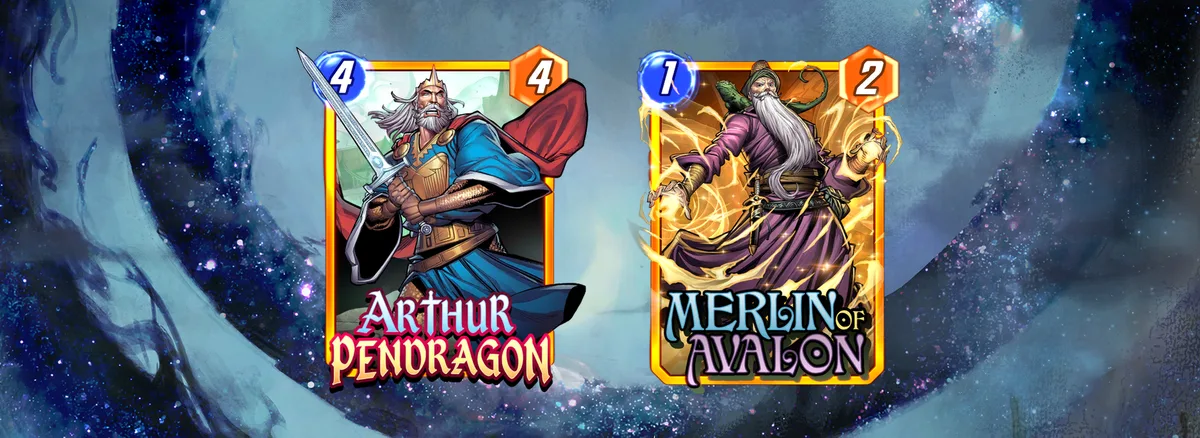
Arthur and Merlin ask different deck-building questions. Learn how to test their official effects, manage lane space, plan turns and decide whether either pass card fits your collection.
Start with the effect you can actually support
Knights of Avalon brings Arthur Pendragon and Merlin of Avalon into Marvel Snap's Season Pass choices. Second Dinner's official preview gives each card a clear job. Arthur brings Excalibur into play and rewards cards costing four or more. Merlin adds The Grand Design to your hand and wants created cards to make that payoff cheaper. Those are different plans, even though they share the same season artwork.
Before changing a deck, look at the cards you already own. A collection with several reliable expensive plays may make Arthur easier to test. A collection that creates extra cards may have more to do with Merlin. Neither connection guarantees a winning list. It gives you a starting hypothesis that you can test in actual matches, rather than buying a pass because a preview picture looked strong.
Card text and availability can change, so read the current client as well as the announcement. This guide uses the published effects and focuses on decisions that remain useful when a particular list changes: turn planning, lane space, draw consistency and resource discipline. If a card is not yet live in your region, treat its section as preparation rather than a final verdict.
- Arthur: leave room for Excalibur before filling a location.
- Merlin: count created cards played, not merely generated.
- Change only a few deck slots between tests.
Arthur's real cost includes lane space
Arthur's On Reveal effect pulls Excalibur to his location for free. Excalibur then gives your four-Cost-or-higher cards an ongoing Power bonus. The free pull sounds simple, but both cards need a place on the board. If a lane is already crowded, you may block a later play or make your final turns too easy for an opponent to read. Count spaces before you drop Arthur.
Try a basic test: play Arthur in a lane where you can afford to reserve one extra slot, then keep the other two locations flexible for your larger cards. If you find yourself repeatedly holding a four-Cost card because every lane is full, the problem may be your deck's board occupancy, not Arthur's raw Power. Replace one space-hungry card and repeat the test.
Excalibur is an Ongoing effect, so consider what happens if the location or the effect is disrupted. The official preview confirms its role, but it does not promise that a specific counter will appear in every match. Build a deck that can still contest at least one lane without the bonus. A single attractive combo should improve a solid plan, not carry every possible game by itself.
Merlin rewards created cards, but timing still matters
Merlin's On Reveal adds The Grand Design to your hand. The Grand Design costs less for each created card you have played and gives Power to one of your cards at each other location. It invites a deck that generates cards and spreads presence across lanes. The key is that created cards must actually be played; merely generating them does not advance the published discount.
When testing Merlin, note how many created cards you played before The Grand Design appeared, not how many were added to hand. A hand full of generated cards can look promising while leaving no energy or board space for the payoff. Try a small number of reliable generators first. If you add too many, you may dilute the cards that win lanes or run into the hand limit.
The effect points at other locations, so place Merlin with the rest of your turn in mind. Ask which lanes have a friendly card ready to receive Power and which lane you can afford to leave quieter. The official description does not give a solved play order. Your job is to turn its broad idea into a repeatable turn sequence that survives a less-than-perfect draw.
Four-Cost cards are a theme, not a rulebook
Several announced Knights of Avalon cards reward expensive plays. Captain Britain is scheduled for November 3 and can give Power to a four-Cost-or-higher card while reducing a card's cost in your hand. Lancelot, scheduled for November 10, rewards cards with increased Power. Elder Dragon of the Moon and Sir Percy Black Knight arrive later in November with different cost-reduction conditions.
That schedule matters for your deck today. A list built around an unreleased card cannot be tested yet. Instead, build a simple Arthur shell using cards already available, then revisit it when each weekly card enters the client. Change one or two slots at a time. If several cards are replaced at once, it becomes difficult to tell which addition improved your games.
Do not fill every slot with four-Cost cards just because the season mentions them often. You still need early plays, interaction and a way to spend energy efficiently when the draw is awkward. If turn four is your first meaningful action, a quick opponent may establish too much board presence. A curve is a plan for bad draws as well as good ones.
Play around the announced locations without depending on them
Niamh's Lake is scheduled to premiere November 11 and draws a four-Cost card from your deck. Round Table follows November 25 and reduces the cost of cards costing four or more. Both can make the season's theme more visible in matches. Neither is a dependable foundation for every game because a location only matters when it appears in your match.
If Niamh's Lake appears, look at your hand before filling its lane. Drawing a useful four-Cost card is valuable only when you can play it on a meaningful later turn. If Round Table appears, plan how the discount changes your final two turns. A lower cost can enable an extra play, but it may also tempt you to spend cards before you know where your opponent is committing.
Keep a short match note: did the location create a win you could not achieve otherwise, or would the deck have worked without it? That distinction stops you from overrating a rare ideal setup. Good deck-building is about how often a plan works, not how impressive it looks in its best screenshot.
Decide whether the pass is worth it for your collection
Second Dinner lists Arthur on Premium and Merlin on Super Premium. The official post also describes a Web Shop bonus for direct purchases and warns that upgrading from Premium to Super Premium later does not trigger it. If you intend to buy, check those exact conditions in the live shop. Spending decisions should be based on what you will receive, not on a vague memory of a promotion.
You can enjoy the season without owning every new card. Sanctum Showdown, Draft and other events have their own schedules and reward paths. Pick the event that matches your available time. If you are free-to-play, watch how the new cards perform against your deck and focus on rewards you can actually earn. A later card may change the value of an early purchase.
The best outcome of a first week is information. Track when Arthur's bonus mattered, whether Merlin's created-card plan came together, and what your losses had in common. After enough games, you will know whether a pass card solves a problem in your deck or simply creates a new one. That is a more reliable guide than a launch-day ranking.
CHECK THE ORIGINALS.
Facts and update details above are based on these official sources. Details can change as the game is updated.
- New Season: Knights of Avalon ↗Second Dinner / Marvel Snap
- Marvel Snap News ↗Second Dinner / Marvel Snap
Loading comments…