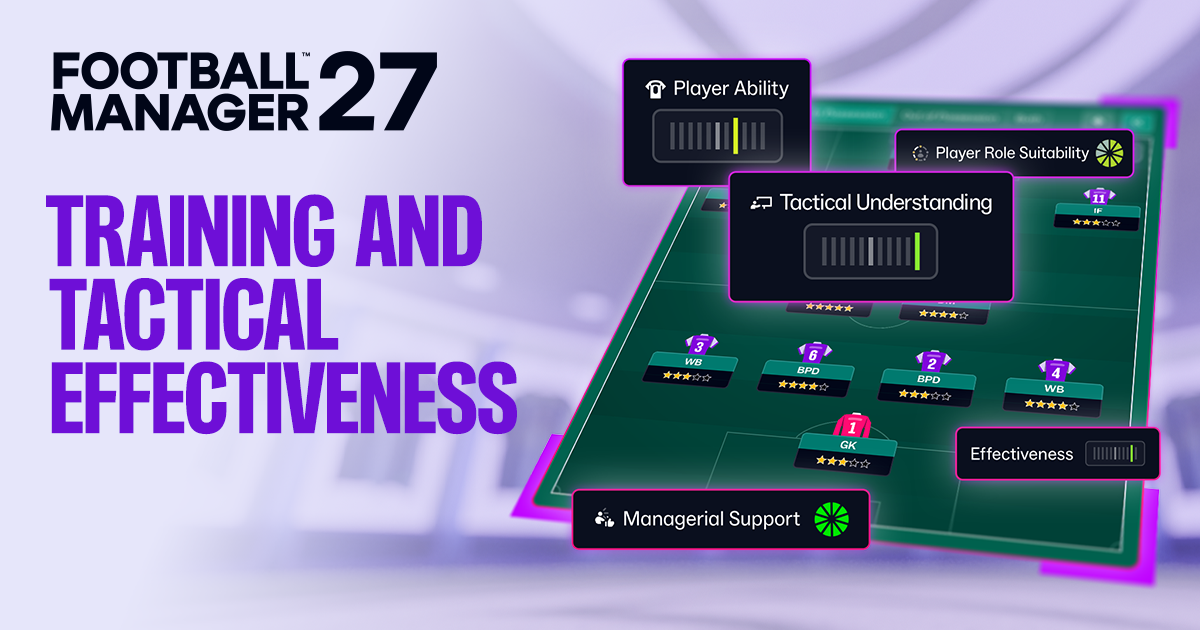
FM27's free PC and Mac preview is a chance to test its new training and Tactical Effectiveness systems. This first-week method turns the official feature breakdown into a simple plan you can adapt to your squad.
Use the preview to learn one team, not every menu
Football Manager 27's free PC and Mac Launch Preview runs until November 3, 2026, according to the official site. That short window is enough to learn whether the new training system suits you, but it is not a reason to click through every screen in a rush. Start with one team, one tactical idea, and a clear question: can this squad execute the way I want it to play? Sports Interactive's new Tactical Effectiveness system is designed to help answer that question across tactics, training, and recruitment.
The most useful first-week experiment is a comparison you can control. Choose a familiar style, play a few matches, then change one meaningful training or instruction variable. Watch the game's gauges and match behavior together. A rising gauge alone does not prove that every pass or press will work. A bad scoreline alone does not prove the tactic is flawed. The value comes from connecting the visible signals with what your players actually do over several fixtures.
This is an editorial method built from Sports Interactive's published explanation, not a claim that we managed your exact club or found a secret winning formation. Squad quality, morale, injuries, schedule, and opposition will vary. The guide aims to give you a repeatable decision process that survives those differences. It also avoids listing an unbeatable tactic, because the developer explicitly frames the new systems around fit, preparation, and tradeoffs rather than one universal setup.
- Pick one tactical identity.
- Check four Tactical Effectiveness areas.
- Change one training focus, then observe several matches.
Read the four gauges as questions, not grades
Sports Interactive says Tactical Effectiveness rests on Tactical Understanding, Player Ability, Player Buy-In, and Next Match Information. Understanding asks whether players know the plan. Ability asks whether they can perform its demands. Buy-In concerns acceptance of what you are asking them to do. Next Match Information reflects preparation for the opponent ahead. The gauges appear in Tactics, Training, and Recruitment. They are useful context, but the developer does not promise a precise win percentage for any combination of values.
Suppose your plan uses relentless pressing, but the ability gauge looks weak. The immediate response should not be to add still more instructions. Check whether the squad has the physical and technical profile for that approach, and whether training is supporting it. If understanding is the weak point, keep the shape stable long enough for familiarity to grow. If buy-in is poor, consider whether your choices and squad management are creating resistance. These are diagnostic hypotheses, not guaranteed solutions; the match engine can reflect several factors at once.
Next Match Information encourages a narrower habit: read the coming opponent and decide what preparation actually matters. You do not need to rewrite the entire tactic for every fixture. Choose one danger to address, such as a strong wide threat or difficult build-up pressure, and set a training focus that supports your response. This keeps the weekly plan connected to an observable reason. If the next match goes badly, you can review whether the preparation was wrong, the execution weak, or the opponent simply better.
Complexity is a cost your squad has to carry
FM27 adds Tactical Complexity, which Sports Interactive describes as a measure influenced by team, player, and opposition instructions. A detailed plan can have a higher long-term ceiling, but players need the talent and time to understand it. The official feature article specifically warns that an elaborate free-flowing or counter-pressing plan may be too much for a lower-league squad. That is a valuable corrective to the habit of treating every tactical toggle as an automatic upgrade.
Begin with the few instructions that express your main idea. If you want to press high, make that the central experiment. If you want controlled build-up, focus on progression and support distances. Leave decorative instructions off until a match gives you a concrete problem they might solve. Watch where possession breaks down and whether players are arriving where you expect. A clear plan can reveal its flaws; a complicated one can hide them behind too many moving pieces.
When you do add complexity, document why. Perhaps an opponent repeatedly finds space behind one full-back, so you adjust that side. Perhaps your forwards are isolated, so you change support. Give the change two or three relevant matches if the schedule allows, then compare. This is not a laboratory with identical opponents, but it is better than rewriting the whole system after one defeat. Sports Interactive says effectiveness can fluctuate with decisions, performances, and events, so patient observation is part of management.
Build the week around the next match
Sports Interactive moved Training to the primary navigation and made recurring schedules easier to copy and paste. Its redesign emphasizes preparing the senior team for the next match, while individual work still supports long-term development. Start each week by identifying the next opponent and the tactical skill your side needs most. If your plan relies on high pressure, select work that supports pressing. If build-up is weak, train that phase instead. These examples come from the developer's own feature description; the exact menu labels may vary by final build.
Check physical load before stacking sessions. The new interface gives clearer visual indicators for current and longer-term load. A plan that looks clever on the tactics screen may become counterproductive if it leaves key players tired for match day. Balance preparation against recovery, especially during crowded fixtures. The goal is not to maximize every gauge every week. It is to arrive at the next game with a coherent plan and enough players ready to execute it.
Keep individual development in view without letting it overwhelm the senior schedule. A young player may need position work or a specific trait over months, while the first team needs a shared pressing or defensive concept by Saturday. Those goals can coexist, but they do not happen on the same clock. Use individual training for players who have a clear development path, then use team sessions to support the immediate fixture. Reassess if minutes, fatigue, or role changes make the original plan less relevant.
Recruit for the tactic you can teach
The Tactical Effectiveness system also appears in scouting. Sports Interactive says reports can help indicate whether a target fits your setup immediately or needs time to learn it. That makes recruitment more than a search for the highest attributes. A talented player who cannot perform your key role may be a longer project than a slightly less glamorous signing who understands the demands. Compare the report with the actual position, role, and squad depth before spending your budget.
If a target looks strong but the tactical fit is uncertain, ask what would have to change. Could training bridge the gap? Would you simplify an instruction for the team? Is there a current player who already gives you most of the benefit at lower cost? This is a useful way to avoid buying a solution to a problem that actually began in your tactical design. It also respects the uncertainty in scouting: reports are information, not a promise that a new signing will transform results on day one.
The same logic applies to the players you already have. If a key squad member struggles with an ambitious role, decide whether the role is essential or simply fashionable. A lower-complexity system may unlock more of the existing team's ability while you build toward a bigger idea. Sports Interactive describes Tactical Effectiveness as a journey that changes over time. Recruitment should support that journey, not force a premature identity onto a squad that cannot yet carry it.
Review the match without trusting one number
FM27 also updates tactical decisions during matches. Sports Interactive says its rebuilt Shouts are more contextual and affect player mental state rather than merely adding a small attribute boost. That means a shout should respond to what you see, not be fired on a fixed timer. If your team is panicking under pressure, observe the pattern before choosing an intervention. If the opponent changes shape, identify the space that opened or closed. The match is evidence, not just an output screen.
After the whistle, write one sentence about your tactic and one about preparation. For example, 'our midfield could not receive under pressure' and 'we spent the week on pressing rather than build-up.' Then decide whether the next training cycle should change. This is a practical review habit, not an official FM27 scoring rule. It helps connect your choices to results without pretending a single match proves causation. Injuries, finishing variance, and opponent quality can all complicate the picture.
If a simple tactic works, resist the urge to add complexity merely to make it look sophisticated. If it fails in the same way repeatedly, change one part and watch again. The new gauges are most valuable when paired with match observation and a clear hypothesis. That is the difference between using Tactical Effectiveness as guidance and treating it as a magic number. Over time you can build a more ambitious style because you know which demands your players are ready to meet.
What to do before November 3
Use the remaining preview time for one compact cycle: choose a team, establish a simple tactical identity, inspect the four gauges, prepare for two matches, and review whether your training focus matched the problem you saw. If your schedule is tight, skip exhaustive recruitment searches. The goal is to understand the new system well enough to decide whether you want to continue the save at full release. The official site says the free Launch Preview is available through November 3; consult your storefront for the current local cutoff.
Keep a short note of your tactic and training choices. When you return, you will remember why you made them and can test a second approach. If you find a strong result in one fixture, do not call the system solved. If your first week goes badly, do not assume the feature is broken. Sports Interactive's own description emphasizes adaptation and fluctuating effectiveness. A preview is most useful as a place to learn what questions to ask, not as a race to build a perfect club overnight.
The best takeaway from FM27's training overhaul is a habit: make the match plan, training plan, and player profile agree with one another. The new gauges make mismatches easier to see, but the manager still has to decide what to simplify, what to practice, and whom to trust. That is a more interesting challenge than copying a tactic without understanding it. Let your team's first few games tell you where the work belongs, and use the official feature notes when a menu or mechanic is unclear.
FAQ
When does the FM27 free Launch Preview end?
The official FM27 site says the PC and Mac Launch Preview is free until November 3, 2026. Check its current storefront notice for the local cutoff time.
What are the four Tactical Effectiveness areas?
Sports Interactive lists Tactical Understanding, Player Ability, Player Buy-In, and Next Match Information.
Is a more complex tactic always stronger?
No. Sports Interactive says complexity can exceed a squad's ability to execute it, especially at lower levels.
CHECK THE ORIGINALS.
Facts and update details above are based on these official sources. Details can change as the game is updated.
- FM27: Training and Tactical Effectiveness ↗Sports Interactive
- FM27: Tactical Tweaks and Match Engine Upgrades ↗Sports Interactive
- Football Manager 27 is free to play until 3 November ↗Sports Interactive
Loading comments…